Showing posts with label Line. Show all posts
Monday, August 29, 2011
Contour vs. Gesture Drawings
Thursday, March 10, 2011
Classroom Collage
These Campbell's soup cans came from here, and when I saw them I so badly wanted to do something like that for our Art Show this spring.
My friend Suzanne who recently posted on this blog gave me the idea to go draw the Melba Butte then we could blow it up and use it as our art instead of the soup can. Then we could cut it up into equal parts and have each child contribute to a scene of the butte.
Currently I have the butte drawn up, and cut up, but this after noon I am going in to the classroom to have the children color their parts. I will take some pictures so that I can post it when we are done.
If you are interested in doing this project let me know and I can give you my drawing and other little tips.
Below are some more Campbell's soup cans.
Another place I found on the web of some fun children's art displayed in a show is here.
Friday, October 1, 2010
Wire
A fun idea to use in the classroom that would help the students understand a bit more on how important line is, is to use wire.
. 
| Artist Alexander Calder |
I have personally had a lot of fun using wire in multiple projects. When I was up at college, I was in an art class and a girl had used different colored wire to make a picture of a face. I was so intrigued!
| Artist Polly Verity |
A few years later I decided that I would get the guts up to try to wire sculpt myself. I tried not to cut my wire too much as I thought it would be much more fun to use one continuous line to design an object. The result was so fun. I made many animals with swirly, springy looking wire.
| Made by Stefan, a wire sculpture out of paper clips? |
All you mothers out there have used pipe cleaners I am sure.
You could simply buy a package or two of pipe cleaners and give the class an assignment of sculpting an animal, or a flower, or even their neighbor.
How simple is that? Can you imagine how excited they would get while working with that? I can.
If I were working with younger children I would most definately suggest using pipe cleaners, but if you are going with an older age, why not go to the hardware store and just ask for a coil of wire. They have a variety of it and it is fairly inexpensive. You would just need to be aware that the thicker the wire the more difficult it will be to bend, thus the use of tools (like pliers) may be needed. If you go with the wire, just cut it into equal amounts before going into the classroom and maybe be prepared with a simple example for your pupils to get an idea from.
Monday, September 20, 2010
Simple Line
| unknown |
| Continuous Line artist unknown |
Supermarket by Ben Schahn
These are all great examples of line by the famous artist Pablo Picasso
Friday, September 17, 2010
A Few Line Ideas
Good Vibrations
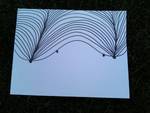
Let's call this is a Line Vibration.
The items you will need are:
Paper
Pencils, crayons, pens, or fine-tip markers
1. Have your kids place their paper in a horizontal position and draw a wavy line across the paper. At the bottom of each "valley", Have them place a very small dot.
2. Then announce the rules of this game: they are to draw more wavy lines, but all lines mush run reasonably parallel until they reach the dots. At each of these dots or "kissing points" the lines must briefly touch before continuing their journey.3. When the upper part of the paper has been completed, the lower half of the paper is done in the same way, using the same "kissing points".
*Some of the most interesting creations appear when new "kissing points" are added as the picture develops. As a rule, the closer the lines, the better the results.
Patterned Fun
Let's call this a simple scribble.
You will need:
Paper
Pencil and crayons
1. Begin by presenting your class a sample of a simple scribble. Tell them that today we each will need to draw a simple scribble. (Make sure to bring extra paper for those who have difficulty leaving their scribble nice and open.)
2. Once they have used their pencils to draw a large, open scribble, have them add a few additional outside lines so that the whole paper is divided into compartments.
3. Next, explain that today the crayons will be used for drawing lines and, furthermore, that these lines will be arranged to create patterns. At this point take time out to demonstrate a few line patterns.
4. When everyone has the idea of line patterns, explain that each of the compartments of the scribbled sheet are to be patterned in a different way.
5. And finally, when they are done, have them out line the compartment boundaries with a black crayon.
I simply used a black sharpie marker for this example.
Just imagine what it would look like in bright colorful crayon.
Patterned Fun 2
This could be an easy art lesson to follow the last one.
Just have the kids draw a simple drawing. Then when they are through tell them that they are to do as they did in the last lesson, use their crayons to make patterned lines. This time they will be using these lines to color in their simple drawing. They could draw anything. The most important part is to have them draw big and simple so that they might be able to fit a pattern inside the object they have drawn.
These examples today came from a book by Gene Baer titled Paste, Pencils, Scissors, and Crayons.
Thursday, September 9, 2010
Define Line
As I was reading for help on how to describe Line further, I found a perfect definition in an old textbook that I used in college. The book is titled Design Basics, fourth edition written by David A. Lauer and Stephen Pentak.
"Of all the elements in art, line is the most familiar to us.....we have been making lines constantly since we were young children. Most of the cartoons we see daily in our newspapers are simple line drawings.
Line is capable of infinite variety. A curious feature of line is its power of suggestion. What an expressive tool it can be for the artist! A line is a minimum statement, made quickly with a minimum of effort, but seemingly able to convey all sorts of moods and feelings.....Think of all the adjectives we can apply to lines. We often describe lines as being nervous, angry, happy, free, quiet, excited, calm, graceful, dancing, and having many other qualities. The power of suggestion of this basic element is great."
1978 Susan Rothenberg
Untitled
Sheep Drawing by Henry Moore
Now, can you see how line can be so interesting?
Let's take a look back to that definition I used earlier:
" Line is capable of infinite variety. A curious feature of line is its power of suggestion. What an expressive tool it can be for the artist! A line is a minimum statement, made quickly with a minimum of effort, but seemingly able to convey all sorts of moods and feelings.....Think of all the adjectives we can apply to lines. We often describe lines as being nervous, angry, happy, free, quiet, excited, calm, graceful, dancing, and having many other qualities. The power of suggestion of this basic element is great."
Wednesday, September 8, 2010
LINE
This Month I would like to highlight the art element of line. As you can see, line can do much. As I first teach children about line, I ask them what a line looks like. It is always interesting to see what they are thinking. I then talk to them about how line doesn't have to be straight, or thin. I have them practice drawing lines diagonally, then horizontally, then vertically, then swirly, then fat, then zig zags, then whatever.
Having the children then design a bookmark with a pattern of different lines would be fun.
Last year I heard of an Art Mom who used cooked spaghetti noodles to have the kids find what they could design with them. I also heard of another Art Mom who just had the kids use their Elmer's glue to draw a simple line with no end (so it has to be a loop of some sort) and then she sprinkled salt on it like you would with glitter. After it was dry she let the kids water color the salt line they had made. It was beautiful.
For older children it would be fun for them to sit and draw a neighbor with one continuous line. (something like the second picture posted).
I also like the idea on the third picture that is posted. With squiggly line make a sculpture of the human body. You could ask for a volunteer to pose for the class, or this may be much easier, print up a picture of a person and give each child a copy. Have the kids try to sculpt the body they are looking at with squiggly lines.
When I was in high school, I loved to do crazy designs like the one in the 4th picture that is posted. I loved to work for hours on something that looked kind of silly. Just think what little kids could come up with. They are still so full of imagination. Use it to your advantage.
The art element of line could be used all year long.
It is my favorite I think.
Subscribe to:
Posts (Atom)